


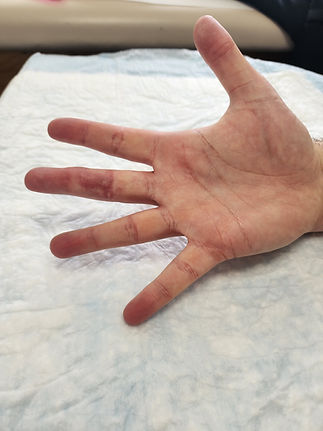
Flexor Tendon Lacerations
Flexor tendon lacerations are significant injuries. These tendons allow you to bend your fingers and grip objects, and when they are cut, even partially, the hand cannot function normally.
Modern surgical techniques have greatly improved outcomes. My focus is on a strong, precise repair that supports early motion and predictable recovery.
Common Symptoms
You may notice:
-
Inability to bend part or all of a finger
-
Pain or swelling along the palm or finger
-
A finger that remains unnaturally straight
-
Numbness if nerves are also involved
-
A cut to the palm, finger, or wrist after a sharp injury
These injuries require prompt evaluation.
What is Different About These Injuries
Flexor tendons run through narrow tunnels in the hand and finger called pulleys. Successful repair must address:
-
The quality of the cut ends
-
Restoring tendon length and tension
-
Ensuring the repair fits through the pulleys without catching
-
Encouraging early controlled motion without compromising repair strength
This balance is what makes modern flexor tendon surgery highly technique-dependent.
Diagnosing Flexor Tendon Injuries
Evaluation includes:
-
Detailed history of the injury
-
Examination of which joints bend or don’t bend
-
Assessment for nerve or blood vessel involvement - if a nerve is also cut, it may need to be repaired or reconstructed during a flexor tendon repair surgery
-
Consideration of wound contamination or crush injury
Imaging (such as X-rays or ultrasound) may be used if there is concern for foreign bodies or associated injuries.
Treatment Options
For an acute flexor tendon injury, non-surgical treatment is generally not successful. This is because the tendon ends retract from one another, and they are not able to reconnect by themselves.
I use advanced flexor tendon repair strategies designed to maximize strength and glide.
WALANT (Wide Awake Local Anesthesia No Tourniquet)
For many patients, WALANT allows:
-
Intraoperative active finger motion
-
Confirmation that the repair glides smoothly
-
No sedation or general anesthesia
-
Less swelling and stiffness afterward
This technique dramatically improves the ability to fine-tune the repair.
CoNextions Tendon Repair System (For Select Candidates)
For appropriate patients, I offer the CoNextions system, which:
-
Provides a strong, reproducible core construct
-
Minimizes suture bulk
-
Facilitates smooth tendon glide
-
Supports early motion protocols
Not every injury pattern qualifies, but in the right scenarios it meaningfully improves repair performance.
Traditional Multi-Strand Core Repairs
In other cases, I use high-strength multi-strand core suture repairs with epitendinous augmentation, designed to maximize durability and allow early, safe motion.
After Surgery - Phase II
Flexor tendon recovery depends heavily on hand therapy.
A surgeon can do a technically-perfect job, but if the rehabilitation after surgery isn't also top-notch, the results can suffer significantly.
Each repair is paired with a structured early-motion program:
-
A custom protective splint will be made by a certified hand therapist (CHT)
-
Guided active or passive motion to prevent stiffness, with the help of a CHT
-
Protection of the repair during the early healing phase
-
Gradual progression to strengthening
Close communication with your certified hand therapist ensures consistency and safety.
My Philosophy
My approach is centered on:
-
A strong, smooth-gliding repair
-
Coordination with expert hand therapists
-
Precise adjustment and tailoring of technique to your injury pattern
-
Protection of long-term hand function
-
Clear expectations so you know exactly what lies ahead
Flexor tendon injuries are technically demanding, and require a lot of work from the patient to do the rehab exercises, but modern techniques give us the tools to achieve excellent outcomes.